Green Gram Farming in India: Complete Moong Cultivation Guide
A complete moong farming guide covering season, soil, field preparation, seed, sowing, water, nutrients, weeds, crop health, harvest and storage.
Quick answer
Quick answer
Green gram (moong or mung bean) is Vigna radiata, a short-duration pulse grown in different kharif, spring-summer and rice-fallow systems. Good cultivation combines an adapted variety, well-drained soil, correct plant population, early weed control, soil-test-based nutrition, moisture at flowering and pod formation, integrated crop protection, and timely harvest of mature pods.
Key takeaways
- Moong season, seed rate and spacing differ among kharif, summer and rice-fallow systems.
- Good drainage supports emergence, roots and nodulation.
- Flowering and pod formation need moisture attention without standing water.
- Yellow mosaic and storage pulse beetles need prevention and monitoring, not blind spraying.
- Harvest planning must account for uneven pod maturity and shattering risk.
What is green gram farming?
green gram farming is the field production of Vigna radiata for clean, mature seed. Green gram, moong and mung bean are common names for the pulse crop Vigna radiata. A successful crop is not created by one input: it comes from locally suitable seed, a uniform plant stand, drainage, timely weed control, balanced nutrition, crop monitoring and careful harvest.
This guide follows the full sequence from field planning to storage. It deliberately separates broadly useful principles from institution-specific examples because Indian recommendations change across production zones.
Crop practice changes with state, district, variety, season, soil test, rainfall and irrigation. Use the figures in this article as examples from named institutions, not as a universal prescription. Confirm seed, nutrient and crop-protection decisions with the current package of practices from your State Agricultural University, Krishi Vigyan Kendra (KVK) or agriculture department.
Which climate and season suit moong?
Direct answer: choose the officially recommended local window in which the crop can emerge in warm soil, receive dependable early moisture and approach harvest without prolonged rain. Moong can be grown in kharif, irrigated spring or summer, and some rice-fallow windows. The right window depends on the locally recommended variety, rainfall pattern, heat, available irrigation and whether pods can mature in reasonably dry weather.
Do not choose a date from a national article alone. Work backwards from the maturity duration of the selected variety and the likely rainfall or irrigation pattern. Delayed sowing can alter pest pressure and push flowering or maturity into unfavourable weather; premature sowing can leave seed in dry or cold soil.
Which soil is suitable?
Direct answer: a well-drained field with a fine but not powdery seedbed, good aeration and no persistent standing water is the safest starting point. Moong establishes best in a well-drained, aerated seedbed. A soil that seals, stays saturated or has an unmanaged hard layer can reduce nodulation, root health and uniformity. Test soil before applying amendments or nutrients.
Test before you prescribe
Collect a representative soil sample before the season. Use the report to understand reaction, salinity, organic carbon and available nutrients. Correct a diagnosed constraint through the locally recommended method; do not apply lime, gypsum, micronutrients or extra fertiliser merely because a generic article lists them.
How should the land be prepared?
- Remove or manage residues in a way that does not obstruct sowing or carry avoidable disease.
- Repair bunds and drainage outlets before rain or irrigation.
- Create a level, friable seed zone so small seeds receive even depth and seed-to-soil contact.
- Avoid repeated tillage that turns the surface into dust or creates a compact layer below.
- Mark rows or beds to match the chosen sowing and interculture equipment.
How do you select seed?
Select a notified or locally recommended variety from an authorised source. Check the label, lot details, germination information, treatment status and physical purity. Food-grade grain is not automatically suitable seed. Use seed of a locally recommended mungbean variety with known germination, disease reaction and maturity habit. Select the production system - pure crop, intercrop, summer or rice fallow - before copying a seed-rate example.
Where seed treatment, inoculation or bio-input use is recommended, follow the sequence and compatibility guidance issued for that product and variety. Some treatments are not compatible when mixed together, and untreated seed may require a different plan.
What seed rate, depth and spacing should be used?
Seed-rate example: TNAU lists 20 kg/ha for a pure greengram crop and 30 kg/ha for a particular rice-fallow system, while regional packages elsewhere may differ. Germination, seed size, sowing method, season and target plant population all affect the practical rate.
Depth example: Placement should reach moist soil without burying seedlings too deeply. For example, Punjab Agricultural University describes 4-6 cm placement for its summer-moong system; other soils and seasons need their local recommendation.
Spacing principle: TNAU gives a 30 x 10 cm example for one greengram system, while PAU lists narrower row spacing for summer moong in Punjab. These differences show why variety and regional package matter more than a single national number.
Calibrate the seed drill or sowing method before covering the whole field. After emergence, count plants at several representative points rather than judging only the best patch. Thin or gap-fill only where the local recommendation and crop stage allow it.
How should moong be sown?
- Confirm seed moisture, germination and treatment status.
- Sow into a workable seedbed with adequate moisture, not saturated mud.
- Keep depth uniform and avoid seed clustering.
- Close the furrow gently for seed-to-soil contact without hard compaction.
- Record variety, lot, date, field and inputs for later diagnosis.
- Inspect emergence early so crusting, gaps, insects or drainage failures are noticed promptly.
How should irrigation be managed?
Moong needs enough moisture for emergence, flowering and pod development but does not tolerate standing water well. Irrigation interval is a field decision based on soil, weather, rooting and crop stage rather than a calendar alone.
Inspect moisture below the surface, not only the colour of the topsoil. Give water in a way that reaches the active root zone without long ponding or runoff. Repair low spots and blocked channels. Stop routine irrigation as the crop approaches the locally defined maturity stage so harvest and drying are not unnecessarily delayed.
How are nutrients managed?
Use a soil-test-based plan. Account for the preceding crop, manure or compost, irrigation water and the locally recommended nutrient schedule. Uniform placement and correct timing matter as much as the total quantity. More fertiliser does not guarantee more yield and can worsen lodging, delayed maturity, salt injury or nutrient imbalance.
Watch crop colour and growth across the whole field. A pale or stunted patch can result from waterlogging, root disease, compaction, poor nodulation, salinity or insects as well as nutrient shortage. Diagnose before applying a corrective spray or fertiliser.
When is weed management most important?
Early weed control protects a short-duration crop from losing light, moisture and nutrients. TNAU describes two hand weedings at 15 and 30 days when herbicide is not used in its system; adapt operations to crop growth and local advice.
Start with a clean field and prevent weeds from setting seed. Select mechanical, manual or registered chemical options only after considering crop stage, soil moisture, weed species, equipment and the current local label. Avoid deep interculture that damages roots.
Which pests and diseases need monitoring?
Walk a consistent route through the field at least weekly and more often when weather favours an outbreak. Check undersides of leaves, growing points, stems, flowers and developing pods. Record the distribution: a field-edge problem, low-spot problem and scattered whole-field problem often have different causes.
Scout first, identify the problem correctly and combine resistant varieties, field sanitation, balanced nutrition, drainage, crop rotation, conservation of beneficial organisms and need-based action. Pesticide registrations and labels change. This guide does not give pesticide doses; use only products currently registered for the crop and follow the label plus local agricultural advice.
How is the crop harvested?
Pods do not always mature together. TNAU rice-fallow guidance uses about 80% mature pods as a harvest indicator. Check pod colour, seed hardness, weather risk and the shattering habit of the chosen variety before deciding whether to pick pods or cut whole plants.
Harvest samples from several places because borders and low areas may mature differently. Keep the cut crop or picked pods off bare, damp soil. Use clean sheets, floors, tools and bags to reduce stones, soil, other seeds and moisture entering the lot.
How are drying, cleaning and storage handled?
- Dry the harvested material promptly in thin, managed layers or bundles appropriate to the crop.
- Thresh gently enough to limit seed damage and loss.
- Winnow and clean out plant pieces, soil, stones, weed seed and visibly damaged grain.
- Measure moisture where possible and meet the buyer, food-safety or seed-standard target for the intended storage system.
- Cool the lot before bagging; never seal warm seed that is still releasing moisture.
- Use clean, dry, labelled bags or containers on pallets, away from walls, leaks and direct sun.
- Inspect stored lots for heating, odour, condensation, insects and moisture migration.
What determines yield and saleable quality?
- Adapted variety and genuine seed
- Uniform establishment and plant population
- Drainage plus timely moisture at critical stages
- Early weed control and accurate crop-health diagnosis
- Balanced, soil-test-based nutrition
- Timely harvest with low shattering or pod loss
- Clean threshing, measured drying and protected storage
Which decisions must be local?
| Decision | Why it varies | Best place to confirm |
|---|---|---|
| Variety and seed class | Season length, disease reaction, seed colour or market class, and notified area differ. | State Agricultural University, KVK or authorised seed source |
| Sowing date and plant population | Rain onset, temperature, irrigation, soil texture and machinery change the workable window. | Current district crop calendar and variety recommendation |
| Nutrients and amendments | Soil-test values, preceding crop, organic inputs and yield target are field-specific. | Soil-test report interpreted with the local package of practices |
| Crop-protection action | Pest identity, natural enemies, threshold, product registration and label directions change. | Field diagnosis and current green gram advisory |
| Harvest and storage target | Buyer specification, intended use, seed certification, weather and available drying equipment differ. | Buyer or seed-standard requirement plus measured lot condition |
Continue learning about the crop
Continue with the moong sowing-season guide, soil and climate guide, seed-to-harvest journey, irrigation guide, crop-health guide and harvest and storage guide.
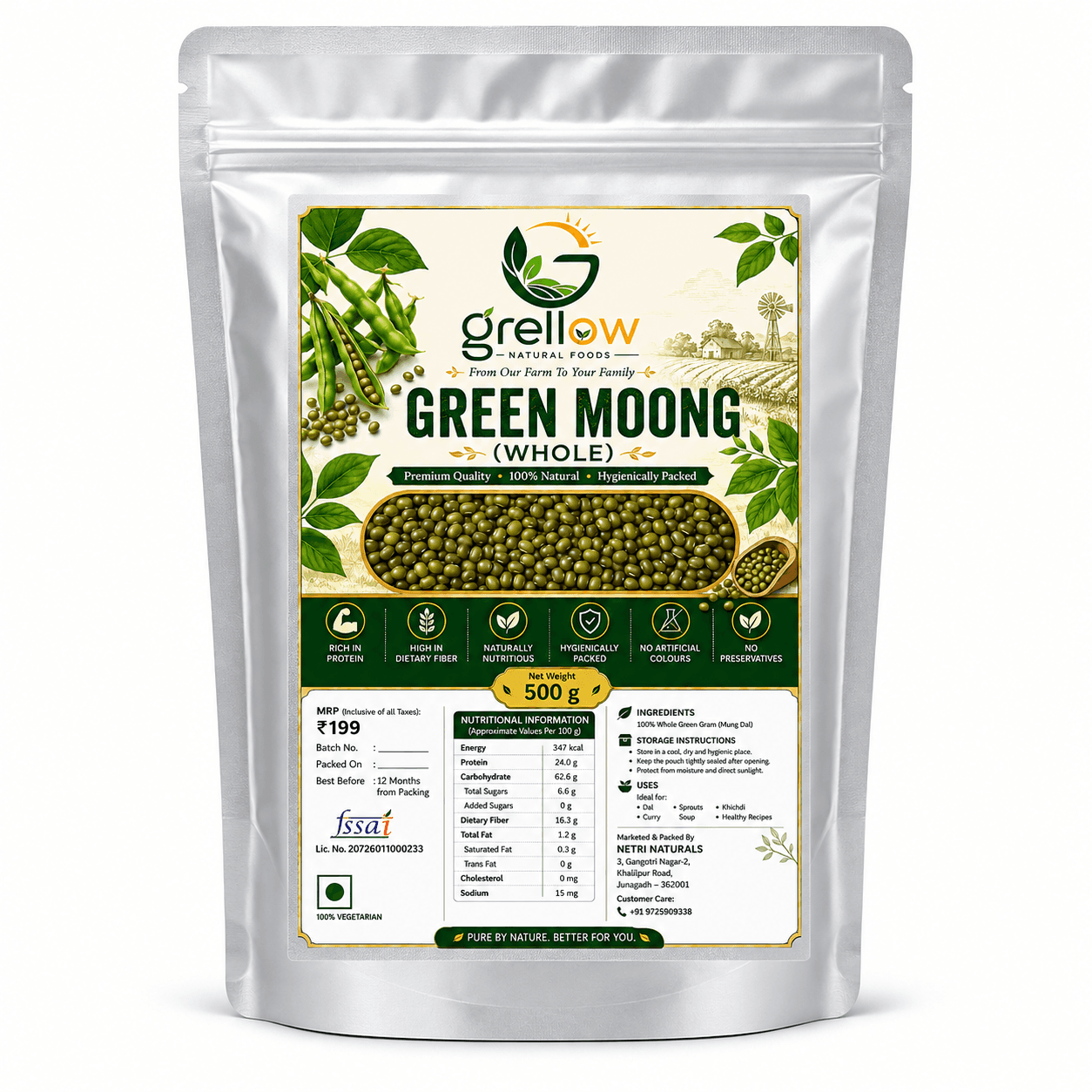
After learning how the crop is grown, cleaned and handled, you can explore Grellow Whole Green Moong (Sabut Moong). The product link is for food buyers; seed for cultivation should come from an authorised source and match the locally recommended variety.
Useful definitions
- Green gram
- The pulse crop Vigna radiata, also called moong or mung bean.
- Nodulation
- Formation of root nodules associated with nitrogen-fixing bacteria in a compatible legume system.
Frequently asked questions
What is green gram?+
Green gram is the pulse crop Vigna radiata, commonly called moong or mung bean. Whole green moong is the mature edible seed.
Which season is suitable for moong farming?+
Moong is grown in different kharif, irrigated spring-summer and rice-fallow windows. Use the local variety and district calendar for the chosen system.
Which soil is best for green gram?+
A well-drained, aerated field with a workable seedbed is generally suitable. Diagnose pH, salinity and nutrients through representative soil testing.
How much moong seed is needed per hectare?+
The rate changes by seed size, germination and system. TNAU lists 20 kg/ha for one pure-crop system and 30 kg/ha for a rice-fallow example; local packages may differ.
When does moong need irrigation most?+
Uniform emergence, flowering and pod development deserve close moisture attention. Avoid standing water and base intervals on soil and weather.
When is green gram harvested?+
Harvest when a representative majority of pods shows varietal maturity, while considering uneven ripening, rain and shattering. Some systems pick pods; others cut whole plants.
Sources & references
- Crop Production Guide: Greengram — Tamil Nadu Agricultural University Agritech Portal
- Package of Practices for Rabi and Summer Crops — Punjab Agricultural University
- Indian Farming: Summer Mungbean in Cereal-Based Cropping Systems — Indian Council of Agricultural Research (2025)
- Irrigation Management for Greengram — Tamil Nadu Agricultural University Agritech Portal
- Rice-Fallow Greengram Production — Tamil Nadu Agricultural University Agritech Portal