Sesame Plant Growth Stages: From Seed to Harvest
Understand sesame germination, emergence, vegetative growth, flowering, capsules, seed filling, maturity, harvest and the management focus at each stage.
Quick answer
Quick answer
Sesame grows through germination, emergence, seedling establishment, vegetative growth, branching, bud formation, flowering, capsule formation, seed filling, maturity and harvest. Variety and weather change the calendar, so farmers should record visible stages. Emergence, early weed competition, flowering, capsule formation and maturity are especially useful management checkpoints.
Key takeaways
- Visible crop stages are more transferable than fixed calendar days.
- Small seedlings need uniform shallow placement and protection from crusting.
- Flowering and capsule formation connect moisture and crop-health decisions with yield.
- Maturity sampling helps reduce shattering loss.
What are the growth stages of a sesame plant?
Direct answer: sesame moves through germination and emergence, seedling establishment, vegetative growth, branching, flower-bud formation, flowering, capsule formation, seed filling, physiological maturity and harvest. Calendar days vary by variety, season and weather, so field signs are more reliable than a universal timeline.
Crop practice changes with state, district, variety, season, soil test, rainfall and irrigation. Use the figures in this article as examples from named institutions, not as a universal prescription. Confirm seed, nutrient and crop-protection decisions with the current package of practices from your State Agricultural University, Krishi Vigyan Kendra (KVK) or agriculture department.
Sesame growth stages at a glance
Use visible field signs rather than one universal calendar
| Stage | Visible change | Management focus |
|---|---|---|
| Germination | The seed absorbs water and the root begins to grow. | Moist, aerated seed zone and shallow, even placement |
| Emergence | Small seedlings break the surface. | Crust, insects, gaps, standing water and early weeds |
| Vegetative growth | Leaves, roots and stems expand. | Plant population, drainage, nutrition and weed control |
| Branching and bud formation | Plant architecture develops and flower buds appear. | Uniform growth and accurate diagnosis of stress |
| Flowering | Tubular flowers open progressively on the plant. | Moisture, pollinator-safe crop protection and crop health |
| Capsule formation | Fertilised flowers develop into capsules. | Protect reproductive growth from severe stress |
| Seed filling | Seeds gain dry matter and varietal colour. | Adequate moisture without waterlogging or unnecessary late growth |
| Maturity | Leaves and stems yellow; capsules and seeds reach varietal signs. | Frequent sampling and harvest readiness |
| Harvest and curing | Plants are cut or pulled and seed is released after managed drying. | Limit shattering, contamination and uneven moisture |
Stage 1: Germination and emergence
Sesame seed is small. A level, friable seed zone and shallow placement help the young shoot reach the surface. ICAR-IIOR describes shallow placement around 2.5 cm and warns against deep sowing because the small seed may establish poorly. Inspect the field soon after expected emergence for crusting, washed seed, ant or insect damage, and ponded low spots.
Stage 2: Seedling establishment
Count plants in several representative areas. Uneven stands may come from seed quality, depth, moisture, crust, compaction or pests. Thin crowded stands only according to the local recommendation and avoid disturbing roots when the surface is very wet.
Stage 3: Vegetative growth and branching
Leaves capture light and roots explore the soil. Branching habit differs by variety and affects spacing. Weed competition is especially important early: the ICAR-IIOR package highlights sensitivity in the first 20-25 days and continued competition up to roughly 40 days after sowing.
Stage 4: Bud formation and flowering
Flowers appear progressively rather than all at once. Moisture stress around flowering can reduce reproductive growth. If crop protection is needed, avoid harming pollinators and follow the current crop label and local timing advice.
Stage 5: Capsule formation and seed filling
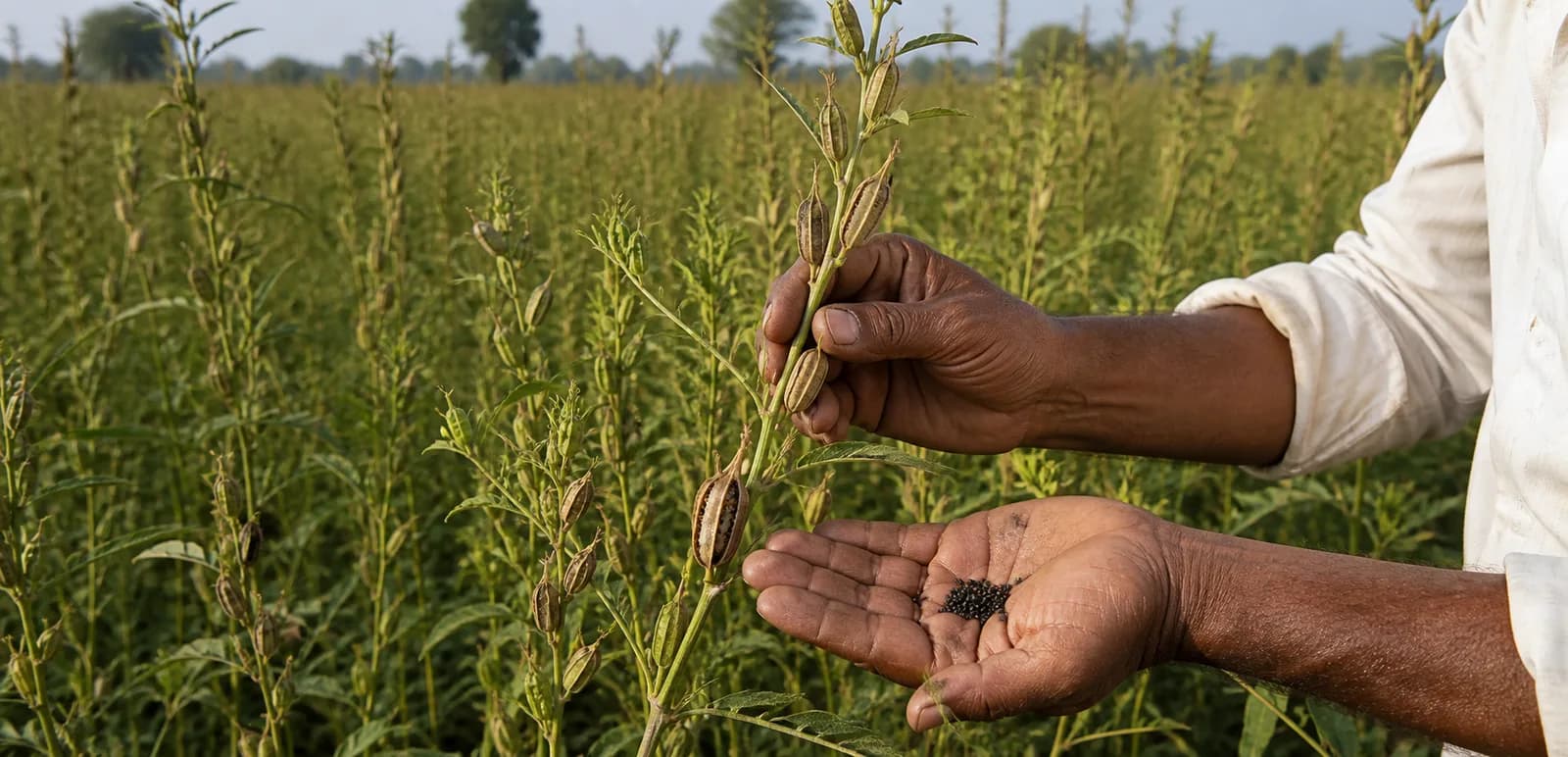
Capsules develop along the stem and branches. Seed begins acquiring the size and colour of the variety. ICAR-IIOR identifies flower initiation and capsule formation as important stages for water in irrigated or moisture-limited crops. Standing water remains harmful.
Stage 6: Physiological maturity
The crop shifts from green growth toward yellowing and drying. Sample capsules from different positions and plants. TNAU describes combined signs including lower-leaf shedding, stem and upper-leaf yellowing, capsule colour change and full varietal seed colour. Do not wait for every capsule to open.
Stage 7: Harvest, curing and threshing
Cut or pull at the locally recommended stage and keep plants on a clean surface. Managed stacking or curing allows remaining mature seed to dry, after which the plants are shaken or threshed. Catch falling seed and clean the lot before final drying and storage.
Do black and white sesame have different growth stages?
The stage sequence is the same because both are Sesamum indicum. The actual timing, branching pattern, capsule arrangement, seed colour and maturity behaviour can differ among varieties. Use the varietal description to recognise full seed colour: dark for kala til, pale for safed til, or the stated shade for another market class.
How can stage-based observation improve diagnosis?
Link every symptom to the crop stage when it appeared. Missing seedlings after emergence, early weed competition, flower loss, poorly filled capsules and late uneven maturity have different likely causes. Stage records narrow the investigation and make photographs or samples more useful to a KVK or diagnostic laboratory.
Compare affected and healthy areas, then review rainfall, irrigation and field operations around the relevant stage. This is more reliable than attributing every weak patch to fertiliser shortage.
How should stages guide field records?
Record the date when a representative part of the field reaches emergence, first flowering, capsule formation and maturity. Add rainfall, irrigation and major observations. These records help explain performance and improve next season's variety and sowing-window decisions.
Continue with stage-specific guides
Use the sesame irrigation guide, sesame pest and disease guide and harvest and storage guide alongside the full til cultivation guide.
Frequently asked questions
What are the main stages of sesame?+
Germination, emergence, seedling establishment, vegetative growth, branching, bud formation, flowering, capsule formation, seed filling, maturity and harvest.
How long does sesame take to grow?+
Duration varies by variety, region, season and stress. Use the official varietal duration and field stage observations rather than a universal number.
When does sesame flower?+
Flowering timing depends on variety and environment. Record first and widespread flowering in the field because it is an important moisture and crop-health stage.
Where do sesame seeds form?+
Seeds form inside capsules that develop after flowers. Capsule number, set and filling contribute to the final seed lot.
What shows that sesame is mature?+
Combined signs include lower-leaf shedding, yellowing stems and upper leaves, capsule colour change and full seed colour of the variety.
Sources & references
- All India Coordinated Research Project on Sesame and Niger: Sesame Production Package — ICAR-Indian Institute of Oilseeds Research
- Crop Production Guide: Sesame (Gingelly) — Tamil Nadu Agricultural University Agritech Portal
- Sesame Harvesting and Maturity Symptoms — Tamil Nadu Agricultural University Agritech Portal