White Sesame Seeds Farming in India: Complete Safed Til Cultivation Guide
A complete safed til farming guide for India covering variety, season, seedbed, sowing, water, nutrients, crop health, harvest, cleaning and storage.
Quick answer
Quick answer
White sesame seeds (safed til) come from pale-seeded varieties of Sesamum indicum. Cultivation needs an adapted variety, a well-drained field, uniform shallow sowing, early weed control, adequate moisture at reproductive stages, accurate crop-health monitoring and timely harvest. Keep pale-seeded lots clean and separate, and confirm all rates and dates through local recommendations.
Key takeaways
- White seed colour is a varietal and market trait, not a separate crop species.
- Use an authorised variety recommended for the local season and buyer requirement.
- Drainage, establishment, early weeds and reproductive-stage moisture drive crop performance.
- Clean harvesting and segregation protect the appearance of safed til.
What is white sesame seeds farming?
white sesame seeds farming is the field production of Sesamum indicum for clean, mature seed. Safed til is a pale-seeded sesame variety or market class, not a different species. A successful crop is not created by one input: it comes from locally suitable seed, a uniform plant stand, drainage, timely weed control, balanced nutrition, crop monitoring and careful harvest.
This guide follows the full sequence from field planning to storage. It deliberately separates broadly useful principles from institution-specific examples because Indian recommendations change across production zones.
Crop practice changes with state, district, variety, season, soil test, rainfall and irrigation. Use the figures in this article as examples from named institutions, not as a universal prescription. Confirm seed, nutrient and crop-protection decisions with the current package of practices from your State Agricultural University, Krishi Vigyan Kendra (KVK) or agriculture department.
Which climate and season suit safed til?
Direct answer: choose the officially recommended local window in which the crop can emerge in warm soil, receive dependable early moisture and approach harvest without prolonged rain. Sesame is grown in monsoon, post-monsoon and irrigated summer windows in different parts of India. The correct date is the locally recommended window that combines suitable temperature, workable soil and reliable moisture without exposing emergence or maturity to damaging rain.
Do not choose a date from a national article alone. Work backwards from the maturity duration of the selected variety and the likely rainfall or irrigation pattern. Delayed sowing can alter pest pressure and push flowering or maturity into unfavourable weather; premature sowing can leave seed in dry or cold soil.
Which soil is suitable?
Direct answer: a well-drained field with a fine but not powdery seedbed, good aeration and no persistent standing water is the safest starting point. A well-drained, friable seedbed is more important than a fashionable soil label. Sesame can be grown on several soil types, but crusting, compaction, salinity and standing water can weaken establishment and roots.
Test before you prescribe
Collect a representative soil sample before the season. Use the report to understand reaction, salinity, organic carbon and available nutrients. Correct a diagnosed constraint through the locally recommended method; do not apply lime, gypsum, micronutrients or extra fertiliser merely because a generic article lists them.
How should the land be prepared?
- Remove or manage residues in a way that does not obstruct sowing or carry avoidable disease.
- Repair bunds and drainage outlets before rain or irrigation.
- Create a level, friable seed zone so small seeds receive even depth and seed-to-soil contact.
- Avoid repeated tillage that turns the surface into dust or creates a compact layer below.
- Mark rows or beds to match the chosen sowing and interculture equipment.
How do you select seed?
Select a notified or locally recommended variety from an authorised source. Check the label, lot details, germination information, treatment status and physical purity. Food-grade grain is not automatically suitable seed. Confirm that the variety produces the required pale seed colour. Keep seed, equipment and bags free from dark sesame, soil and staining materials because visual purity can affect acceptance.
Where seed treatment, inoculation or bio-input use is recommended, follow the sequence and compatibility guidance issued for that product and variety. Some treatments are not compatible when mixed together, and untreated seed may require a different plan.
What seed rate, depth and spacing should be used?
Seed-rate example: The ICAR-IIOR production package uses 5 kg/ha as a common reference and notes that a seed drill can reduce this to about 2.5-3 kg/ha. That is a planning example, not a replacement for the rate specified for your variety, seed quality and sowing method.
Depth example: ICAR-IIOR describes shallow placement around 2.5 cm and warns against deep sowing because the small seed may establish poorly.
Spacing principle: Spacing changes with branching habit, variety and season. ICAR-IIOR publishes state- and season-specific rows rather than one national layout; TNAU examples also show that local systems differ.
Calibrate the seed drill or sowing method before covering the whole field. After emergence, count plants at several representative points rather than judging only the best patch. Thin or gap-fill only where the local recommendation and crop stage allow it.
How should safed til be sown?
- Confirm seed moisture, germination and treatment status.
- Sow into a workable seedbed with adequate moisture, not saturated mud.
- Keep depth uniform and avoid seed clustering.
- Close the furrow gently for seed-to-soil contact without hard compaction.
- Record variety, lot, date, field and inputs for later diagnosis.
- Inspect emergence early so crusting, gaps, insects or drainage failures are noticed promptly.
How should irrigation be managed?
Sesame is often rainfed, yet it is not indifferent to moisture stress. Establishment, flowering and capsule formation need attention. Prolonged waterlogging is hazardous, and late excess water can delay or disrupt maturity.
Inspect moisture below the surface, not only the colour of the topsoil. Give water in a way that reaches the active root zone without long ponding or runoff. Repair low spots and blocked channels. Stop routine irrigation as the crop approaches the locally defined maturity stage so harvest and drying are not unnecessarily delayed.
How are nutrients managed?
Use a soil-test-based plan. Account for the preceding crop, manure or compost, irrigation water and the locally recommended nutrient schedule. Uniform placement and correct timing matter as much as the total quantity. More fertiliser does not guarantee more yield and can worsen lodging, delayed maturity, salt injury or nutrient imbalance.
Watch crop colour and growth across the whole field. A pale or stunted patch can result from waterlogging, root disease, compaction, poor nodulation, salinity or insects as well as nutrient shortage. Diagnose before applying a corrective spray or fertiliser.
When is weed management most important?
The ICAR-IIOR package identifies the first 20-25 days as especially sensitive to weed competition and describes competition remaining important up to about 40 days after sowing. Timely interculture and hand weeding must suit row spacing and field conditions.
Start with a clean field and prevent weeds from setting seed. Select mechanical, manual or registered chemical options only after considering crop stage, soil moisture, weed species, equipment and the current local label. Avoid deep interculture that damages roots.
Which pests and diseases need monitoring?
Walk a consistent route through the field at least weekly and more often when weather favours an outbreak. Check undersides of leaves, growing points, stems, flowers and developing capsules. Record the distribution: a field-edge problem, low-spot problem and scattered whole-field problem often have different causes.
Scout first, identify the problem correctly and combine resistant varieties, field sanitation, balanced nutrition, drainage, crop rotation, conservation of beneficial organisms and need-based action. Pesticide registrations and labels change. This guide does not give pesticide doses; use only products currently registered for the crop and follow the label plus local agricultural advice.
How is the crop harvested?
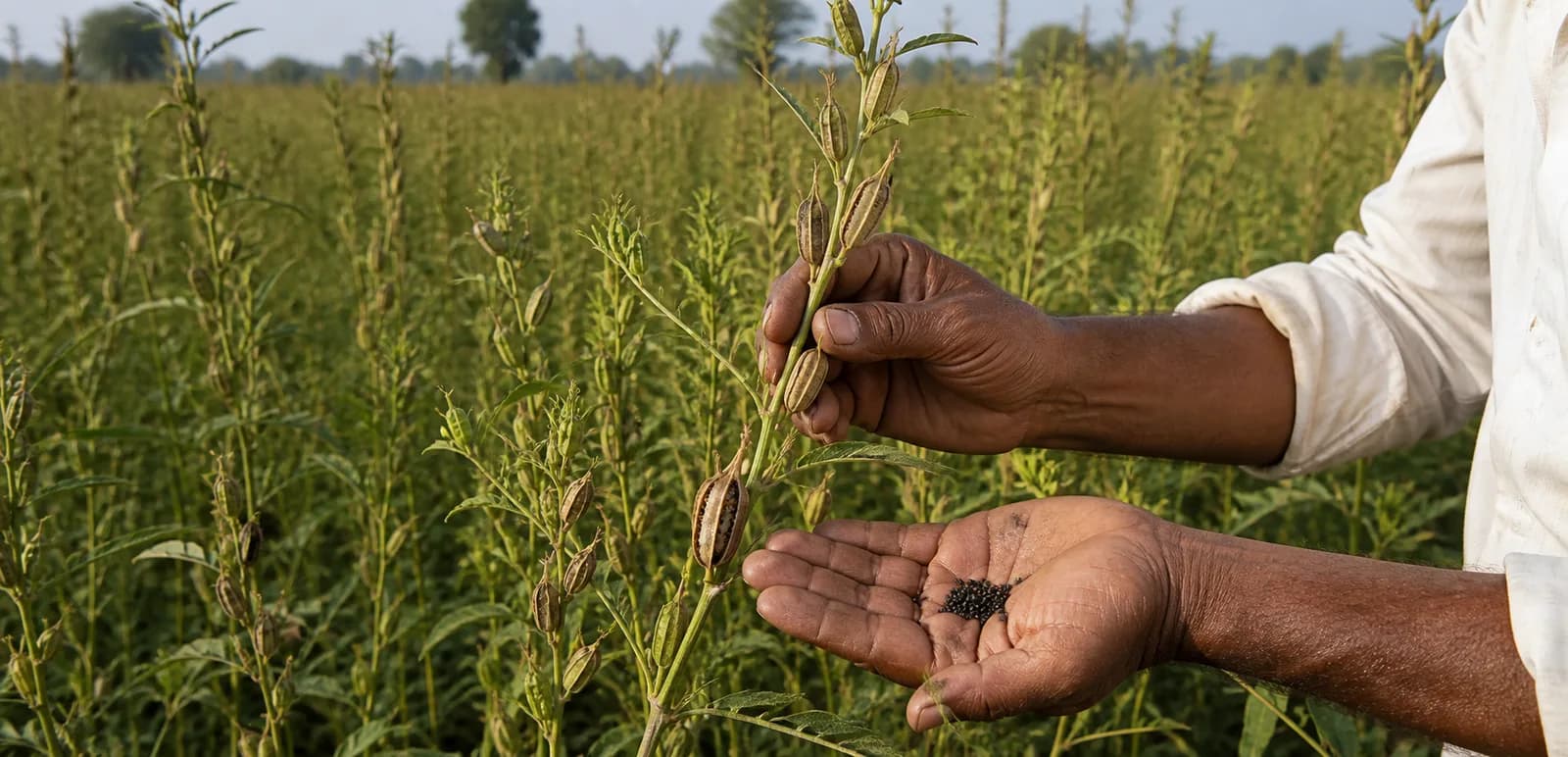
TNAU advises using several maturity signs together: lower-leaf shedding, yellowing of upper leaves and stems, capsule colour change and full varietal seed colour. Harvest before widespread capsule opening causes shattering loss.
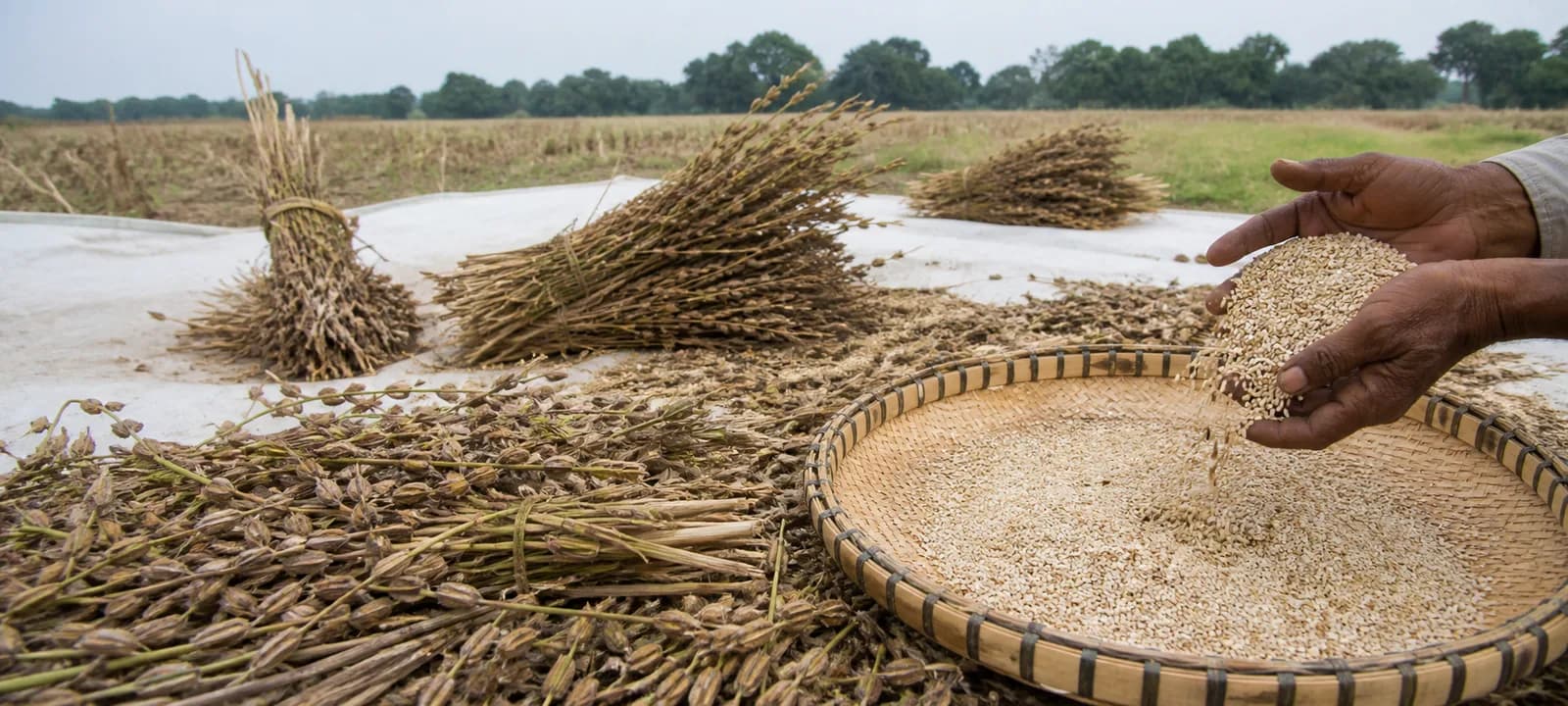
Harvest samples from several places because borders and low areas may mature differently. Keep the cut crop or picked pods off bare, damp soil. Use clean sheets, floors, tools and bags to reduce stones, soil, other seeds and moisture entering the lot.
How are drying, cleaning and storage handled?
- Dry the harvested material promptly in thin, managed layers or bundles appropriate to the crop.
- Thresh gently enough to limit seed damage and loss.
- Winnow and clean out plant pieces, soil, stones, weed seed and visibly damaged grain.
- Measure moisture where possible and meet the buyer, food-safety or seed-standard target for the intended storage system.
- Cool the lot before bagging; never seal warm seed that is still releasing moisture.
- Use clean, dry, labelled bags or containers on pallets, away from walls, leaks and direct sun.
- Inspect stored lots for heating, odour, condensation, insects and moisture migration.
What determines yield and saleable quality?
- Adapted variety and genuine seed
- Uniform establishment and plant population
- Drainage plus timely moisture at critical stages
- Early weed control and accurate crop-health diagnosis
- Balanced, soil-test-based nutrition
- Timely harvest with low shattering or pod loss
- Clean threshing, measured drying and protected storage
Which decisions must be local?
| Decision | Why it varies | Best place to confirm |
|---|---|---|
| Variety and seed class | Season length, disease reaction, seed colour or market class, and notified area differ. | State Agricultural University, KVK or authorised seed source |
| Sowing date and plant population | Rain onset, temperature, irrigation, soil texture and machinery change the workable window. | Current district crop calendar and variety recommendation |
| Nutrients and amendments | Soil-test values, preceding crop, organic inputs and yield target are field-specific. | Soil-test report interpreted with the local package of practices |
| Crop-protection action | Pest identity, natural enemies, threshold, product registration and label directions change. | Field diagnosis and current white sesame seeds advisory |
| Harvest and storage target | Buyer specification, intended use, seed certification, weather and available drying equipment differ. | Buyer or seed-standard requirement plus measured lot condition |
Continue learning about the crop
Compare agronomy in black vs white sesame farming and food use in black sesame vs white sesame seeds. Continue with white sesame sowing season, the farm-to-seed journey and the general sesame cultivation pillar.
After learning how the crop is grown, cleaned and handled, you can explore Grellow White Sesame Seeds (Safed Til). The product link is for food buyers; seed for cultivation should come from an authorised source and match the locally recommended variety.
Useful definitions
- Safed til
- The common Hindi name for white or pale sesame seed.
Frequently asked questions
Is safed til a different species from black sesame?+
No. White and black sesame are seed-colour classes within cultivated Sesamum indicum. Variety and local adaptation determine the field plan.
Which soil suits white sesame?+
A well-drained, friable field without prolonged standing water is generally suitable. Use a soil test and the local package for pH, nutrients and amendments.
Does white sesame need a different fertiliser from black sesame?+
Not simply because of colour. Nutrients should follow soil test, preceding crop, production system and the recommendation for the selected variety and region.
How is safed til kept clean at harvest?+
Use clean sheets, floors, threshers, transport and bags; keep lots separate from dark sesame and prevent soil, plant debris and moisture contamination.
Is a white sesame food pack suitable planting seed?+
No assumption should be made. Use authorised planting seed with a known variety, germination, purity, seed class and treatment status.
Sources & references
- All India Coordinated Research Project on Sesame and Niger: Sesame Production Package — ICAR-Indian Institute of Oilseeds Research
- Crop Production Guide: Sesame (Gingelly) — Tamil Nadu Agricultural University Agritech Portal
- AESA Based IPM Package for Sesame — National Institute of Plant Health Management
- Foundation and Certified Seed Production in Sesame — ICAR-Indian Institute of Oilseeds Research
- Sesame Harvesting and Maturity Symptoms — Tamil Nadu Agricultural University Agritech Portal