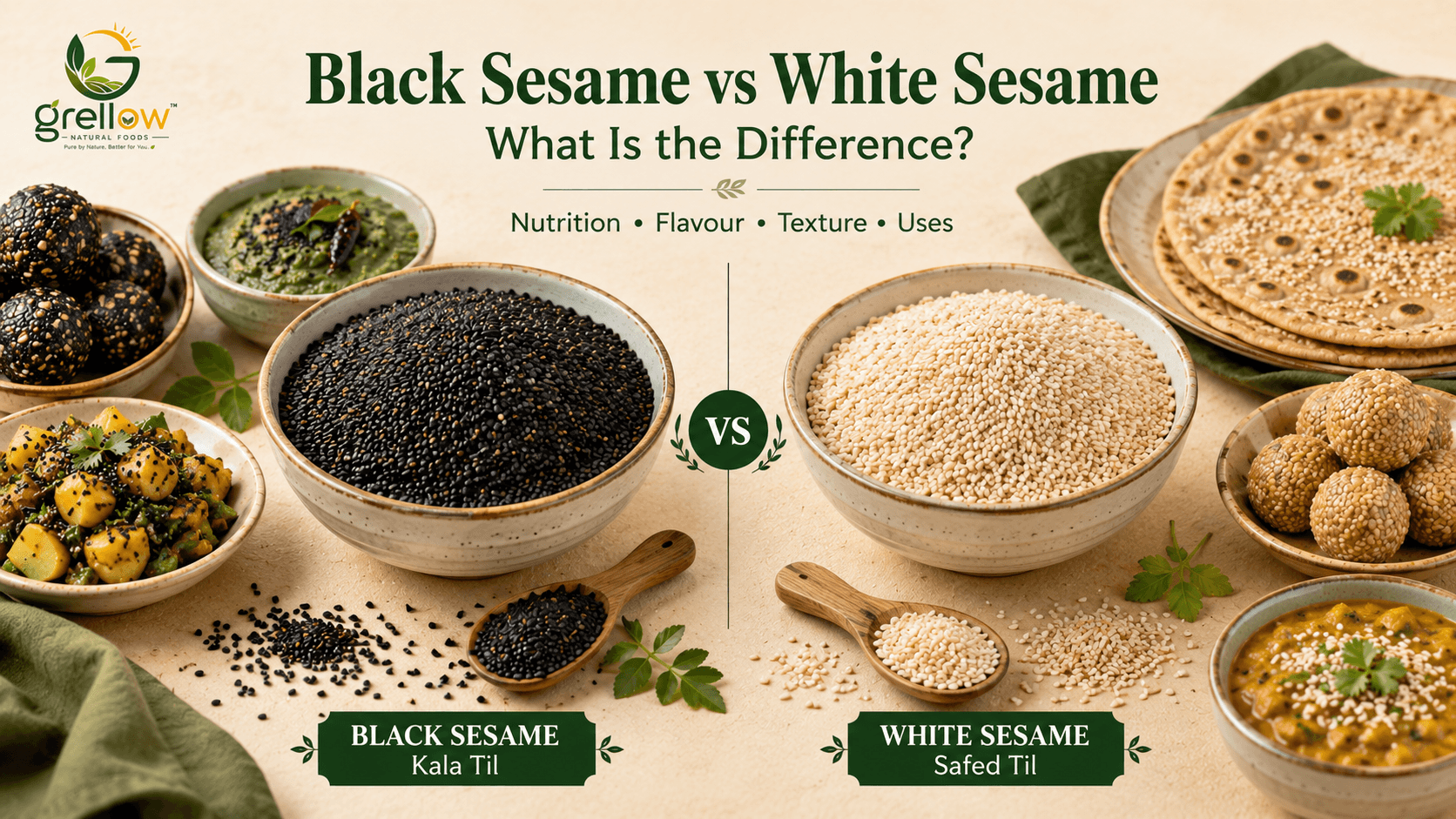
Black Sesame Seeds vs White Sesame Seeds: What Is the Difference?
Compare black and white sesame by appearance, flavour, texture, hull, nutrition, Indian cooking uses and the dishes each suits best.
Quick answer
Quick answer
Black and white sesame seeds come from the same cultivated species but differ in variety, colour, flavour and common preparation. Black sesame is often earthier and more assertive, while white sesame is usually milder. Hull status can affect texture and measured minerals, so colour alone does not determine nutrition. Neither is universally better; choose by recipe, taste and product quality.
Key takeaways
- Black sesame usually brings a stronger roasted flavour and visible contrast; white sesame is milder and blends into many dishes.
- A seed may be hulled or unhulled, and colour does not reliably tell you the hull status.
- Both provide fats, plant protein, fibre and minerals, with values varying by variety and processing.
- The better choice is the one that suits the dish, taste preference, allergen needs and available product information.
Black Sesame vs White Sesame at a Glance
| Feature | Black sesame | White sesame |
|---|---|---|
| Appearance | Black to deep charcoal seeds | Cream, ivory or pale beige seeds |
| Typical taste | Earthier, toastier and more assertive | Milder, nutty and slightly sweet |
| Texture | Can feel firmer, especially when more hull remains | Often softer when hulled; varies by product |
| Hull | Often sold with hull, but not always | Commonly sold hulled or polished, but unhulled versions exist |
| Common Indian uses | Chutney, rice, regional gravies, toppings and dark til sweets | Laddoo, chikki, bakery toppings, tadka, gravies and paste |
| Visual effect | High contrast on curd, rice, bread and vegetables | Blends easily into pale sweets, dough and sauce |
| Nutrition | Fats, protein, fibre and minerals; exact values depend on variety and hull | Similar broad nutrient groups; processing and hull affect figures |
| Best use cases | When robust flavour and dark colour improve the dish | When a mild sesame taste or smooth pale paste is preferred |
Are They Different Plants?
Both are forms of cultivated sesame, Sesamum indicum. Sesame seeds occur in several colours, not only black and white. Variety, soil, climate, harvesting and processing all influence the final seed. Two packs of the same colour can still differ in size, freshness, flavour and hull status.
That is why a useful comparison starts with the actual label. Look for “hulled,” “unhulled,” “natural,” “roasted” or “raw,” and check whether the product is intended for direct eating or further cooking.
How Do Taste and Texture Differ?
Black sesame commonly tastes deeper and slightly more bitter or earthy. When toasted, it works well in robust chutneys, spice blends and savoury rice. White sesame is usually gentler and may taste a little sweeter, which helps it sit comfortably in til-gud sweets, bakery foods and creamy pastes.
Freshness matters as much as colour. Sesame contains substantial fat and can develop a stale, paint-like or bitter flavour when poorly stored. Roast a small quantity and taste it before committing an entire batch to a recipe.
What Does Hulled vs Unhulled Mean?
The hull is the seed's outer layer. Removing it changes colour, texture, some measured nutrients and how smoothly the seed grinds. Unhulled sesame may have a firmer bite and can measure higher for certain minerals concentrated in or near the hull. However, the body's absorption is affected by the food matrix and the whole meal, so a larger laboratory number does not automatically mean a proportionally larger benefit.
Do not assume every black seed is unhulled or every white seed is hulled. Product descriptions should state the processing more reliably than colour.
Is Black Sesame More Nutritious Than White Sesame?
Neither colour is universally more nutritious. Both contain unsaturated fats, plant protein, fibre and minerals. Published values vary because “sesame” samples differ by cultivar, hull and processing. A fair decision should consider the actual product panel, how much the recipe uses and what else is in the meal.
If you want more detail about the nutrient groups without confusing generic values with a product label, read black sesame seeds nutrition.
Which Sesame Works Best in Indian Cooking?
Choose black sesame for
- Dry or wet chutneys where a strong roasted note is welcome.
- Rice dishes and vegetable toppings that benefit from black contrast.
- Regional recipes that specifically call for kala til.
- Seed mixtures where a firm, visible seed is desirable.
Choose white sesame for
- Til laddoo, chikki and sweets where a milder flavour is traditional.
- Tahini-style paste or gravies where a pale, smooth result is preferred.
- Bread, buns, crackers and savoury snack toppings.
- Tadka and vegetable dishes where sesame should blend rather than dominate.
Use both when
A mixed topping can bring contrast without the stronger taste of an all-black batch. Roast black and white sesame carefully; if their sizes differ, roasting separately gives better control.
Does Roasting Change the Choice?
Roasting makes both colours more aromatic. Black sesame's dark surface makes browning difficult to see, so rely on low heat and smell. White sesame shows colour more clearly but can still turn bitter quickly. Remove seeds from the hot pan as soon as they smell nutty.
How to Choose a Good Pack
- Pick an intact pack with a clear ingredient name, net quantity, lot and date information.
- Check whether the seed is raw or roasted and hulled or unhulled.
- Look for clean, dry seeds without webbing, visible moisture or excessive foreign matter.
- Buy a quantity you can use while it still tastes fresh.
- Remember that both colours are sesame allergens.
Which Sesame Seeds Are Better?
For a dark, assertive chutney, black sesame may be better. For a pale paste or mild laddoo, white sesame may be better. For nutrition, no responsible answer can rank every black seed above every white seed without comparable product data. Decide by recipe, sensory preference, hull status, freshness and label information.
Start with the dish rather than a winner. If kala til is new to you, explore 10 easy ways to use black sesame and the main black sesame guide. Grellow does not currently list either sesame product, so no unavailable product is recommended here.
Frequently asked questions
Which is better, black sesame or white sesame?+
Neither is universally better. Black sesame is often stronger and darker; white sesame is usually milder. Choose based on the recipe, hull status, freshness and your taste.
Is black sesame always unhulled?+
No. Black sesame is often sold with more of the hull intact, but colour alone is not proof. Check the product label for hulled or unhulled information.
Do black and white sesame have the same nutrition?+
They contain the same broad nutrient groups, including fats, protein, fibre and minerals. Exact figures vary with variety, hull and processing.
Which sesame is best for laddoo?+
White sesame is common in many til laddoo recipes because of its mild taste, while black sesame is used in specific regional recipes. Follow the intended recipe rather than treating one colour as a rule.
Can black and white sesame be mixed?+
Yes. A mixed topping can add visual contrast and balanced flavour. Roast carefully, and consider roasting separately if the seed sizes differ.
Sources & references
- Indian Food Composition Tables 2017 — ICMR–National Institute of Nutrition (2017)
- Sesame Added as a Major Food Allergen — U.S. Food and Drug Administration