Black Sesame Seeds Nutrition: Calories, Protein, Fats & Minerals
Understand the calories, protein, fats, fibre and minerals in kala til, plus why generic food data should not be mistaken for a Grellow product label.
Quick answer
Quick answer
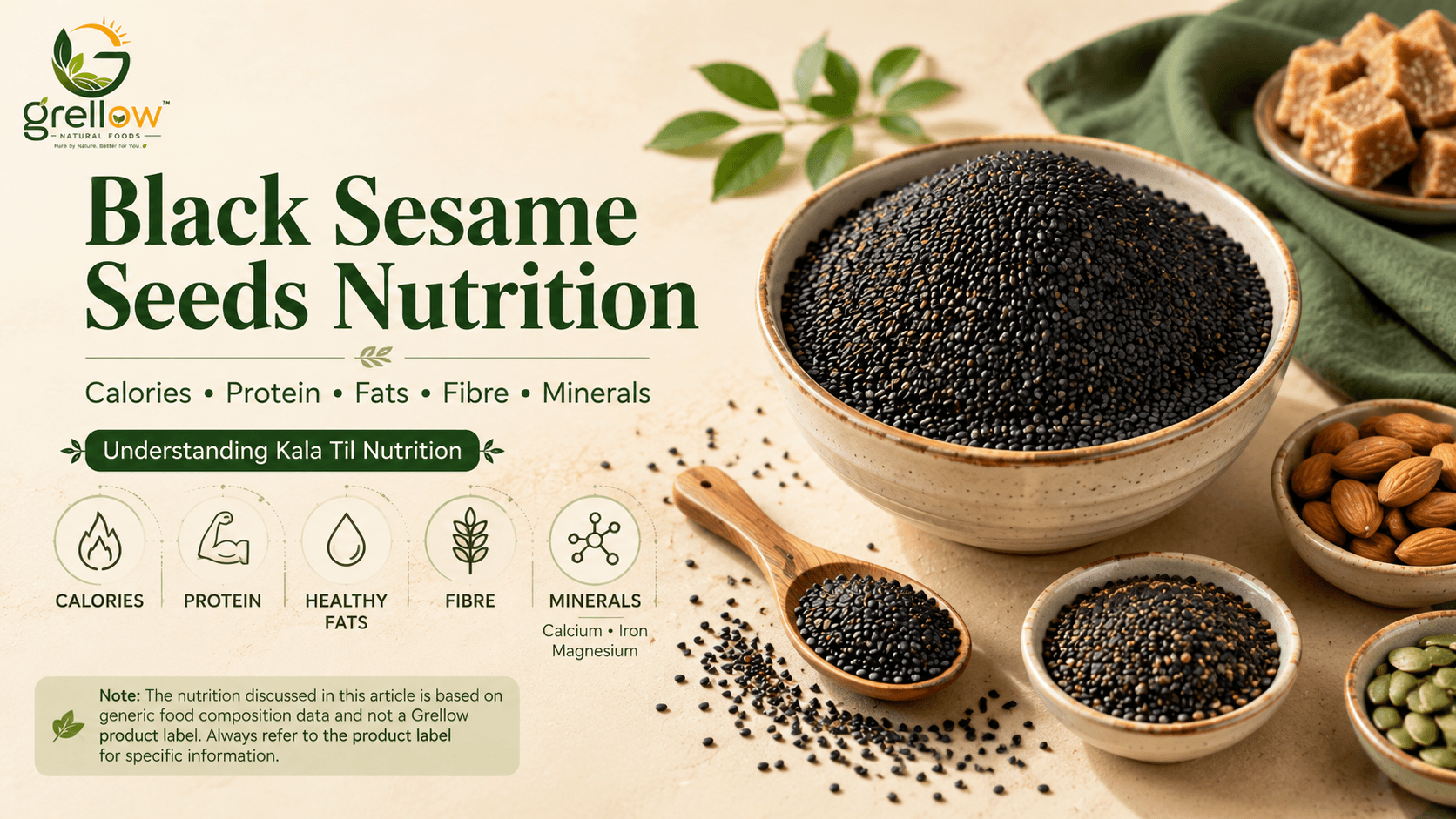
Black sesame seeds are energy-dense seeds whose calories come mainly from fat, alongside plant protein, carbohydrate and fibre. They also contain calcium, iron, magnesium, phosphorus, copper and zinc. Exact nutrition values vary with variety, hull and processing. Because Grellow does not currently list a black sesame product, generic reference data should not be read as a Grellow pack nutrition declaration.
Key takeaways
- Sesame is calorie-dense because it contains substantial fat, much of it unsaturated.
- Kala til contributes plant protein and fibre but is normally eaten in smaller quantities than pulses or whole grains.
- Mineral figures can differ greatly between hulled and unhulled samples.
- Food-composition reference values describe a food sample, not every commercial pack.
- Nutrition value does not turn sesame into a treatment for any disease.
How to Read Black Sesame Nutrition Information
Nutrition tables are useful only when the food and serving basis are clear. A value “per 100 g” helps compare foods but does not describe the amount most people sprinkle on a meal. A label “per serving” depends on the manufacturer's defined serving. Black sesame may also be hulled, unhulled, raw or roasted, each of which can produce different laboratory results.
The Indian Food Composition Tables provide authoritative reference data for Indian foods, but reference data is not a substitute for a specific package label. Grellow does not currently have a black sesame product in its database, so this article explains nutrient groups qualitatively rather than inventing brand-specific numbers.
Calories and Energy Density
Sesame seeds are energy-dense. Most energy comes from fat, with protein and carbohydrate contributing the rest. This is not inherently negative: energy-dense ingredients can add flavour and nutrients efficiently. It does mean that a spoonful and a bowlful are nutritionally different choices.
Use sesame as a measured ingredient in chutney, roti dough, vegetables or sweets. If a til preparation includes jaggery, sugar, ghee or oil, evaluate the finished food rather than attributing the whole dish's nutrition to the seeds.
Protein in Black Sesame Seeds
Kala til contains plant protein. In ordinary culinary use, however, it is a supporting protein source rather than the main one. A balanced Indian meal might combine roti or rice with dal, chana, rajma, dairy, soy, eggs, fish or meat and then use sesame for additional flavour and nutrients.
Protein quality depends on amino-acid pattern and the mix of foods eaten over time. There is no need to force every meal to contain a “complete” protein, but dietary variety is valuable.
Fats in Kala Til
Fat is the largest macronutrient component of sesame. The seed contains a mixture of fatty acids, with unsaturated fats making up an important share. These fats carry energy and help explain sesame's rich mouthfeel and ability to form a paste when ground.
Roasting does not remove the fat. Avoid prolonged high heat that produces a burnt flavour. Ground sesame exposes oils to air, so close the container promptly and store it away from heat and light.
Carbohydrate and Fibre
Sesame contains carbohydrate, including dietary fibre. Fibre is not fully digested and helps add bulk to the diet. A spoonful of sesame contributes some fibre, but larger daily sources normally include vegetables, fruit, legumes and whole grains.
If you add several seed and bran products at once, digestive discomfort can follow. Increase fibre-rich foods gradually and drink adequate fluids unless a clinician has given different advice.
Minerals in Black Sesame Seeds
Calcium
Sesame is known for calcium, but values can change considerably when the hull is removed. Calcium supports normal bones, muscles and nerve function. Sesame can contribute, yet it should not be treated as a direct replacement for all other calcium sources or prescribed care.
Iron
Kala til provides non-haem iron. Absorption from plant foods varies and can be improved when the meal includes vitamin C. A sesame topping cannot diagnose or correct anaemia; suspected deficiency requires proper assessment.
Magnesium and phosphorus
These minerals participate in many normal body processes and contribute to bone structure. Their presence supports the description of sesame as nutrient-dense, not a promise of a specific health outcome.
Zinc
Zinc supports immune function, growth and protein synthesis. Sesame contributes zinc along with other seeds, nuts, legumes and animal foods. Absorption from a single serving depends on the full diet.
Copper and other nutrients
Sesame also contains copper, manganese, B vitamins and naturally occurring lignans. Exact amounts belong in a verified nutrition dataset or product label, not an unsourced marketing claim.
Why Hull Status Matters
| Factor | Why it changes the data |
|---|---|
| Hulled vs unhulled | The outer layer contains material that affects fibre, texture and measured minerals. |
| Raw vs roasted | Moisture changes during heating, which can shift nutrients expressed per 100 g. |
| Variety and soil | Plant genetics and growing conditions influence natural composition. |
| Serving basis | Per-100-g values cannot be compared directly with per-teaspoon or per-serving values. |
| Brand formulation | A pure seed product differs from a salted mix, sweet or chutney containing other ingredients. |
Does Roasting Destroy the Nutrition?
A short, gentle dry-roast is mainly used to develop taste and crunch. Heating can alter some heat-sensitive compounds, while water loss can make other values look more concentrated by weight. The practical priority is to avoid burning the seeds. A nutritious food that tastes scorched is unlikely to be used well.
How to Use Nutrition Data Responsibly
- Check whether the value describes black sesame specifically or generic sesame.
- Confirm raw, roasted, hulled or unhulled status.
- Match the unit and serving size before comparing products.
- Use the actual package declaration for purchase decisions when one is available.
- Consider the complete recipe, especially added sugar, salt and fat.
Nutrition in an Everyday Meal
Black sesame is most useful when it makes a varied meal more enjoyable: crushed into chutney beside dal, stirred into curd, or sprinkled on vegetables. Read the main black sesame benefits guide, learn how to eat kala til, or compare black and white sesame. No Grellow black sesame product relationship has been added because the catalog does not currently contain one.
Frequently asked questions
Are black sesame seeds high in calories?+
Sesame seeds are energy-dense because they contain substantial fat. A small sprinkle and a large bowl are very different servings, so consider the amount and the complete recipe.
Do black sesame seeds contain protein?+
Yes. Kala til contributes plant protein, but the quantity normally used as a topping is smaller than a main protein serving such as dal, beans, dairy, soy, eggs, fish or meat.
Which minerals are found in black sesame?+
Sesame contains calcium, iron, magnesium, phosphorus, copper and zinc. Exact values vary with variety, hull status, processing and the data source.
Is unhulled sesame higher in calcium?+
Unhulled sesame can show higher measured calcium because the hull contributes minerals. The exact difference depends on the sample, and absorption is not identical to the laboratory value.
Are these Grellow black sesame nutrition facts?+
No. Grellow does not currently list a black sesame product, so this guide describes general food-composition information and does not present generic figures as a Grellow pack declaration.
Sources & references
- Indian Food Composition Tables 2017 — ICMR–National Institute of Nutrition (2017)
- Dietary Fiber — MedlinePlus, U.S. National Library of Medicine
- Iron: Fact Sheet for Consumers — NIH Office of Dietary Supplements
- Zinc: Fact Sheet for Consumers — NIH Office of Dietary Supplements