Cinnamon Sticks vs Cinnamon Powder: Which One Should You Use?
Compare cinnamon sticks and cinnamon powder by flavour release, texture and cooking method so you can choose the right form for chai, biryani, curries, desserts and baking.
Quick answer
Quick answer
Choose cinnamon sticks for gradual infusion in tea, biryani, pulao, curries and syrups, especially when you want to remove the spice later. Choose cinnamon powder when it must disperse evenly through batter, dough, fillings or dry seasoning. They are not always interchangeable in equal quantities.
Key takeaways
- Sticks infuse gradually and are easy to remove; powder disperses immediately.
- Whole Dalchini usually suits tea, rice dishes, gravies and clear infusions.
- Powder is usually more practical for baking, fillings and dry mixes.
- Never assume one stick equals a fixed spoonful of powder.
Cinnamon can reach the kitchen in two familiar forms: whole bark pieces and a fine ground powder. Both offer warm, woody aroma, yet they behave differently once heat, liquid and texture enter the recipe. Understanding cinnamon sticks vs cinnamon powder helps you avoid a cloudy drink, an unevenly flavoured cake or a biryani that tastes stronger than intended.
Neither form is universally better. The right choice depends on whether you want a slow infusion or immediate distribution, whether the spice should remain visible, and whether it can be removed before serving. This practical comparison focuses on cooking performance rather than health claims.
What Are Cinnamon Sticks?
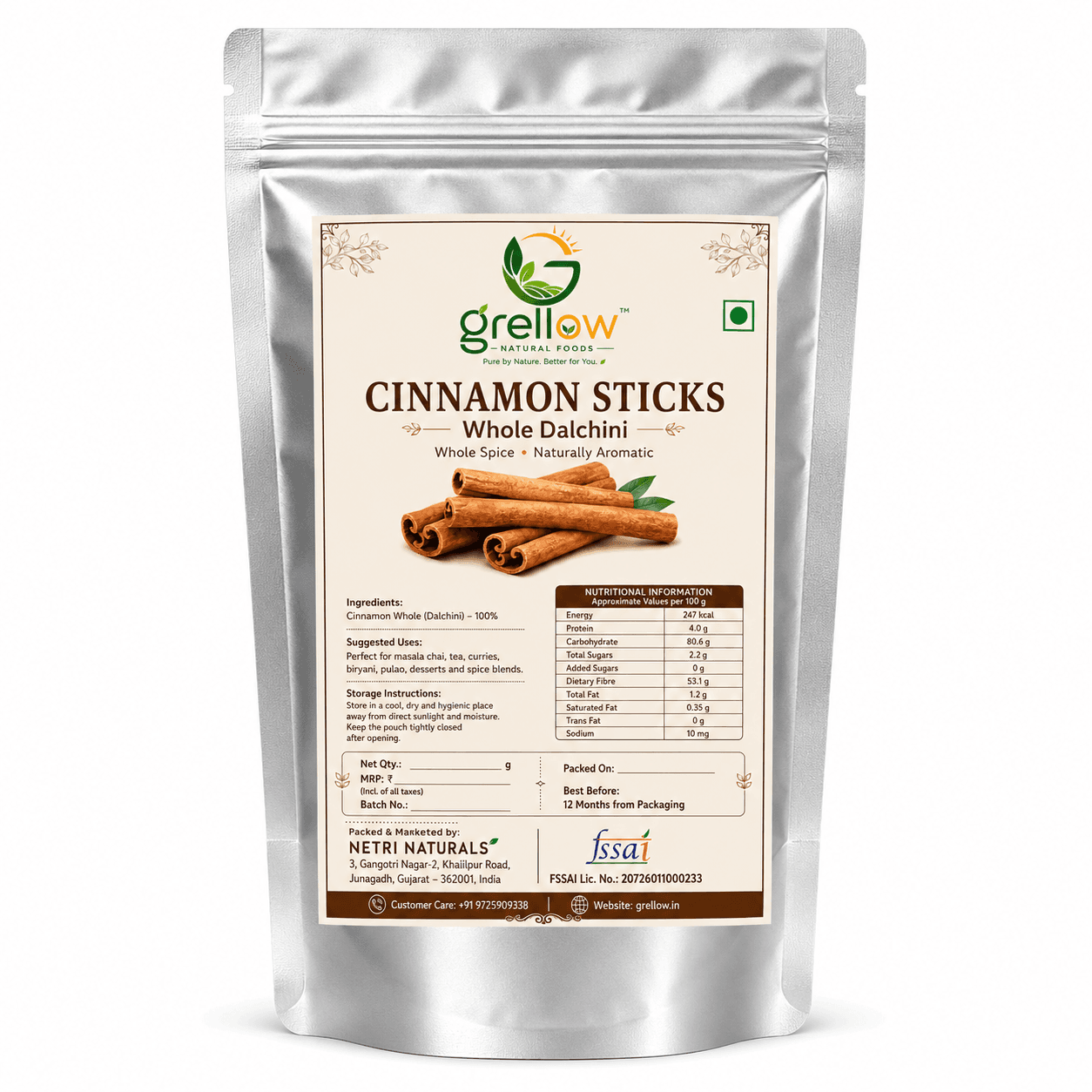
Cinnamon sticks, commonly called whole Dalchini, are dried pieces of cinnamon bark. The Grellow listing describes Grellow Cinnamon Sticks (Whole Dalchini) as a single-ingredient whole spice with a warm, woody and naturally aromatic character. Whole pieces can be used as they are or broken into smaller sections, then removed before serving when appropriate.
Because a stick has less exposed surface area than powder, its flavour generally enters a dish gradually. That makes it useful for simmered drinks, rice dishes, gravies and syrups where ingredients cook together for a while.
What Is Cinnamon Powder?
Cinnamon powder is cinnamon that has been ground into fine particles. It spreads quickly through wet or dry mixtures and cannot be conveniently removed once added. This makes it useful for batters, dough, dessert fillings, toppings and spice mixes.
Powder can feel more direct because a large surface area meets the food immediately. Its texture may be visible in pale drinks or delicate sauces, and too much can make a preparation taste dusty or overpowering. Always follow the recipe and add cautiously.
Cinnamon Sticks vs Cinnamon Powder: Key Differences
Flavour release
Whole Dalchini releases aroma over time as it warms. Powder starts dispersing as soon as it meets liquid, oil or a moist mixture. Choose sticks for a controlled simmer and powder for fast, even mixing.
Texture and appearance
A stick remains a distinct piece. It can flavour tea or syrup without leaving fine particles, provided the drink is strained. Powder becomes part of the finished texture and can slightly darken a mixture.
Removal after cooking
Sticks are easy to lift out of a pot. Ground cinnamon cannot be separated after it is mixed in. This matters in smooth drinks, clear infusions, kheer and gravies.
Measuring and consistency
Powder is easy to measure with a spoon, but its strength can still vary. Sticks differ in length, thickness and compactness. There is no dependable universal conversion between one stick and one teaspoon of powder.
Storage exposure
Both forms should be kept clean, dry and airtight. Powder has more surface area exposed to air each time the container opens, while whole pieces are less finely divided. Good storage and sensible purchase quantities matter for both.
Which Is Better for Tea and Masala Chai?
Cinnamon sticks are usually the more convenient choice for a clear, strained cup. Add a small piece while the water and tea spices simmer, allow it to infuse, and strain before serving. The piece can release flavour without leaving powder floating on the surface.
Powder can work when a recipe specifically calls for it, but it may settle or remain suspended. If using powder, begin with a very small measured quantity and expect a different texture. For step-by-step guidance, see how to use cinnamon sticks in tea and other dishes.
Which Is Better for Biryani and Pulao?
Whole Dalchini is a natural fit for biryani and pulao because these dishes commonly use whole spices. Warm the cinnamon piece carefully with the other aromatics, then cook the rice according to the recipe. Its fragrance spreads as the dish cooks.
Cinnamon powder can distribute unevenly, tint the rice and make the spice harder to control. It may be appropriate in a prepared masala blend, but it is not a direct visual or textural replacement for a whole stick.
Which Is Better for Curries and Gravies?
The answer depends on the gravy. Use a stick when the curry simmers long enough for infusion and when you can remove the piece before serving. This approach suits recipes built around whole-spice tempering.
Powder may be suitable when the spice needs to merge fully into a masala or when the cooking time is short. Add it with care so it does not burn in hot fat. Follow the specific recipe rather than treating cinnamon as compulsory in every curry.
Which Is Better for Desserts and Baking?
For kheer, poached fruit, custard bases and flavoured milk, a stick can infuse aroma and then be removed. It is particularly helpful when you want warmth without visible cinnamon specks.
For cakes, biscuits, rolls, dough, crumble toppings and dessert fillings, powder is usually easier to distribute evenly. A whole stick cannot spread through a batter. However, it can flavour milk or syrup that will later become part of the dessert.
Can You Substitute One for the Other?
Sometimes, but not in a fixed one-to-one ratio. A substitution changes how quickly flavour develops, whether the spice remains visible and whether it can be removed. The size and strength of a stick vary, while powder varies by grind and age.
If a recipe designed for sticks must use powder, add a conservative amount and taste where safe. If a recipe designed for powder must use a stick, ask whether the recipe provides enough liquid and cooking time for infusion. In baking, a stick usually cannot replace powder directly.
Quick Choice Guide
- Masala chai: usually cinnamon stick, strained before serving.
- Biryani or pulao: usually whole Dalchini with other whole spices.
- Slow-cooked gravy: stick for infusion; powder only when the recipe calls for it.
- Kheer or flavoured milk: stick for removable aroma.
- Cake or biscuit batter: powder for even distribution.
- Fruit compote: either form can work, but a stick keeps the texture cleaner.
- Dry spice mix: powder is generally more practical.
How to Get Better Results With Either Form
Start with less, give the spice time to work and record what suited your batch. Avoid burning whole or ground cinnamon. Store both forms away from heat, sunlight, moisture and steam. Use dry utensils and close the package or container promptly.
For a broader introduction to flavour and kitchen applications, visit our complete guide to cinnamon sticks and whole Dalchini. You can also explore 10 everyday ways to use cinnamon sticks.
The Better Form Is the One That Fits the Recipe
Choose cinnamon sticks when you want gradual infusion, a clean texture and the option to remove the spice. Choose powder when even distribution is essential. Paying attention to method is more useful than declaring one form superior.
For recipes that call for whole bark pieces, Grellow Cinnamon Sticks (Whole Dalchini) can be explored as a practical pantry option. Check the current product listing for available pack choices.
Frequently asked questions
Are cinnamon sticks stronger than cinnamon powder?+
Strength cannot be compared by form alone. Powder disperses faster because it has more exposed surface area, while a stick infuses gradually. Freshness, quantity and cooking time all influence the result.
Can I replace cinnamon powder with a cinnamon stick?+
Only in recipes with enough liquid and time for infusion. A stick will not distribute through dry dough or batter like powder, so it is not a direct substitute in many baked recipes.
Which cinnamon form is better for chai?+
A cinnamon stick is often more convenient because it can simmer with the tea and be strained out. Powder may leave fine particles, although it can be used when a recipe specifically calls for it.
Can I use cinnamon powder in biryani?+
Some masala blends contain ground cinnamon, but powder behaves differently from whole Dalchini. For recipes designed around whole spices, use the specified stick rather than making an equal substitution.
How should cinnamon sticks and powder be stored?+
Keep both in clean, dry, airtight containers away from direct sunlight, heat, steam and moisture. Use dry utensils and close the container promptly after each use.
Sources & references
- Grellow Cinnamon Sticks (Whole Dalchini) — Grellow