How Black Sesame Seeds Are Grown: From Farm to Harvest
Follow kala til from certified planting seed through flowering and capsules to harvest, drying, threshing, cleaning and a food-ready black sesame lot.
Quick answer
Quick answer
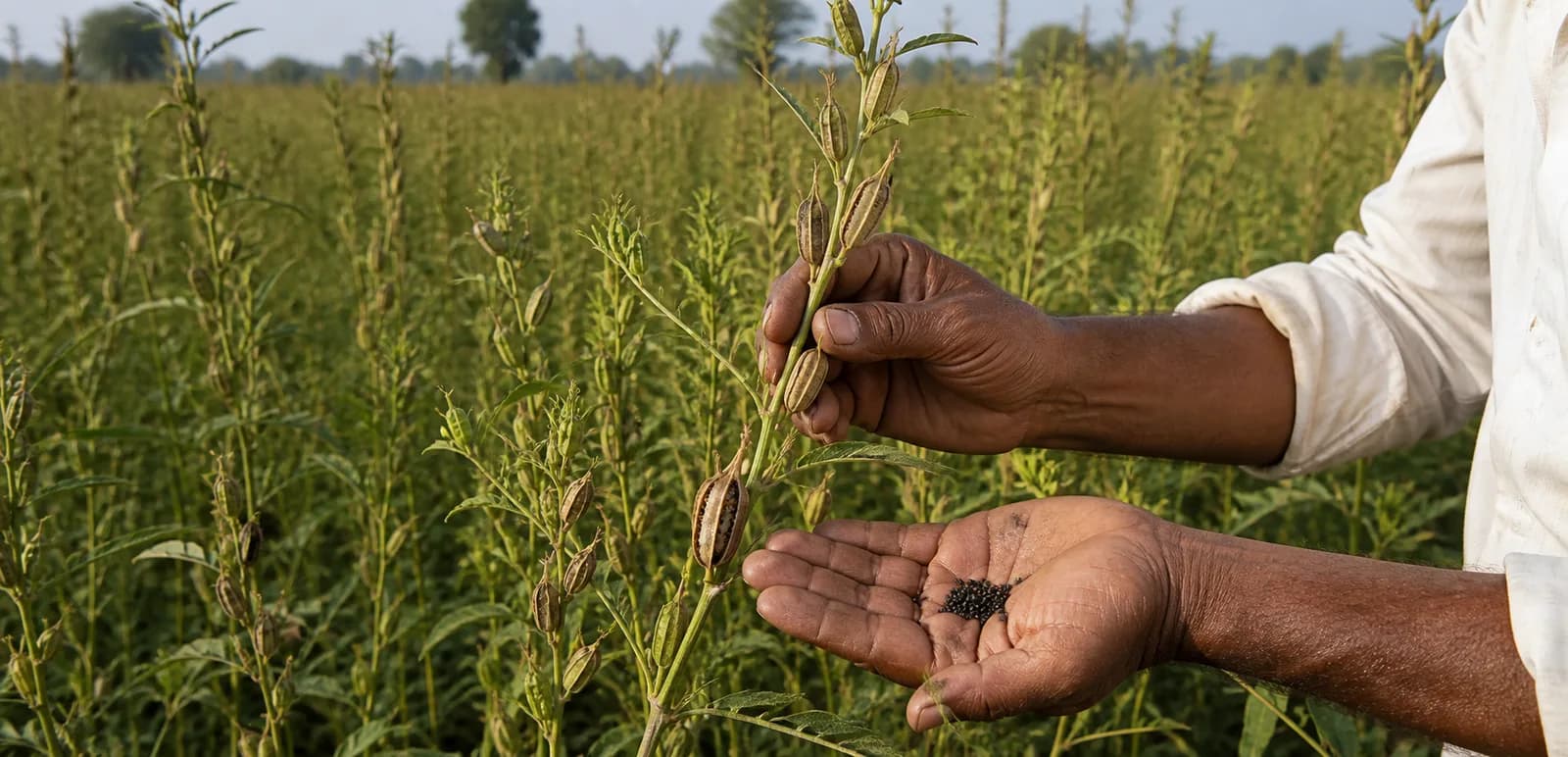
Black sesame starts with a locally adapted dark-seeded sesame variety. The small seed is sown shallowly in a well-drained field, grows into a flowering plant, and forms capsules containing dark seed. Farmers harvest at varietal maturity before heavy shattering, then cure, thresh, clean, dry and store the seed as a traceable lot.
Key takeaways
- Kala til is the seed of a sesame plant, not a processed version of white sesame.
- Flowers develop into capsules that hold many small seeds.
- Harvest timing protects seed from shattering and weather loss.
- Clean drying and segregation connect farm production with food quality.
How is black sesame grown?
Direct answer: black sesame moves through seed selection, sowing, emergence, vegetative growth, flowering, capsule formation, maturity, harvest, drying, threshing, cleaning and storage. Each step protects the next one; a clean retail seed begins with an adapted variety and ends with careful moisture and contamination control.
Crop practice changes with state, district, variety, season, soil test, rainfall and irrigation. Use the figures in this article as examples from named institutions, not as a universal prescription. Confirm seed, nutrient and crop-protection decisions with the current package of practices from your State Agricultural University, Krishi Vigyan Kendra (KVK) or agriculture department.
The farm-to-seed journey at a glance
Every stage protects the quality of the next stage
| Stage | What happens | What the farmer watches |
|---|---|---|
| Seed | A labelled, locally adapted seed lot is selected. | Variety, purity, germination and treatment status |
| Sowing | Small seed is placed shallowly and evenly in moist soil. | Depth, seed distribution and drainage |
| Plant growth | Roots, leaves and variety-specific branches develop. | Stand, weeds, moisture and balanced nutrition |
| Flowering | Flowers open progressively on stems and branches. | Moisture stress, insects and pollinator-safe decisions |
| Capsules | Fertilised flowers become seed-bearing capsules. | Capsule set, crop health and waterlogging |
| Maturity | Plants yellow and seed reaches varietal colour. | Representative sampling and shattering risk |
| Harvest to clean seed | Plants are harvested, cured, threshed, cleaned and dried. | Loss, contamination, moisture and lot identity |
Step 1: Select the field and seed
The field must suit the season and drain well. The seed should be a labelled, locally recommended variety with known germination and treatment status. For a food buyer, seed colour is visible; for a farmer, adaptation, maturity and crop-health characteristics are equally important.
Step 2: Prepare and sow uniformly
A friable, level seed zone lets the drill or sowing method place seed at a consistent depth. ICAR-IIOR describes shallow placement around 2.5 cm and warns against deep sowing because the small seed may establish poorly. Calibrate before the full field, then inspect emergence in several areas rather than only near the entrance.
Step 3: Establish roots and leaves
Young plants build the canopy and root system that will support flowering. Early water stress, crusting, standing water and weed competition can permanently reduce stand uniformity. Check roots and the pattern of symptoms before assuming that pale plants need fertiliser.
Step 4: Flower and set capsules
Flowering connects crop growth to harvestable seed. Moisture stress, waterlogging, severe pest pressure and nutrient imbalance can reduce reproductive growth. Sesame is often rainfed, yet it is not indifferent to moisture stress. Establishment, flowering and capsule formation need attention. Prolonged waterlogging is hazardous, and late excess water can delay or disrupt maturity.
Step 5: Fill and mature the seed
As seed fills, the crop begins shifting from green growth toward maturity. Avoid unnecessary late irrigation or practices that delay drying. Inspect the whole field because soil variation and uneven moisture can create mixed maturity.
Step 6: Harvest at the correct stage
TNAU advises using several maturity signs together: lower-leaf shedding, yellowing of upper leaves and stems, capsule colour change and full varietal seed colour. Harvest before widespread capsule opening causes shattering loss. The goal is to capture mature seed before avoidable shattering, pod opening, rain damage or contamination. Weather forecast, variety habit and labour or machinery availability affect the final decision.
Step 7: Dry and thresh cleanly
Keep harvested material on a clean sheet or floor. Dry it promptly and turn or rearrange it for even airflow. Thresh without mixing in soil, stones, old grain or other varieties. Separate broken, immature and visibly damaged seed during cleaning.
Step 8: Store and move the lot
Measure moisture where possible and meet the standard for the intended market and container. Cool seed before bagging. Label the lot and protect it from roof leaks, damp floors, insects, rodents and odours. Food grain and planting seed may have different quality, traceability and certification requirements.
Why does traceability matter after harvest?
A clean seed lot should be traceable to crop, variety or market class, field, harvest date and storage location. Traceability helps investigate a moisture, admixture or crop-health problem without rejecting unrelated stock. It also prevents planting seed, treated seed and food grain from being confused.
Keep field and store records together: seed-lot label, major operations, harvest observations, drying checks, cleaning date and bag count. A buyer may ask for different quality evidence from a seed-certification agency, so confirm the intended market before claiming a grade.
What does a consumer receive?
A retail pack represents many control points: varietal identity, field cleanliness, harvest timing, drying, cleaning, grading, storage and packing. For ways to use the cleaned food seed, see how to eat kala til and the black sesame nutrition guide.
After learning how the crop is grown, cleaned and handled, you can explore Grellow Black Sesame Seeds (Kala Til). The product link is for food buyers; seed for cultivation should come from an authorised source and match the locally recommended variety.
Useful definitions
- Capsule
- The sesame fruit that develops after flowering and contains the seeds.
How to do it
- 1
Select seed and field
Choose a locally recommended dark-seeded sesame variety and a well-drained field.
- 2
Prepare and sow
Create a friable seed zone and place the small seed shallowly and uniformly.
- 3
Establish the crop
Protect emergence through drainage, moisture and timely early weed control.
- 4
Support flowering and capsules
Monitor moisture, nutrition, pests and diseases as flowers become capsules.
- 5
Check maturity
Sample plants for yellowing, capsule change and full dark varietal seed colour.
- 6
Harvest and cure
Cut or pull at the local stage and keep plants on a clean drying surface.
- 7
Thresh and clean
Release seed, remove foreign matter and preserve the identity of the dark-seeded lot.
- 8
Dry and store
Meet the applicable moisture target, cool the lot and store it cleanly off the floor.
Frequently asked questions
Does black sesame grow black on the plant?+
Yes. A dark-seeded sesame variety develops its characteristic seed colour as the seed matures inside the capsule. It is not made black by roasting white sesame.
Where do black sesame seeds form?+
They form inside capsules that develop after sesame flowers are fertilised. Several capsules can occur along the stem and branches.
Why is sesame sown shallowly?+
Sesame seed is small. Excess depth can make it harder for the seedling to reach the surface and can reduce stand uniformity.
How are kala til seeds removed from the plant?+
Mature plants are harvested and managed through curing or drying, then shaken or threshed so seed leaves the capsules. The lot is then cleaned and dried.
Is food-grade black sesame suitable for sowing?+
Not necessarily. Planting seed should be an authorised, locally recommended lot with known variety, germination, purity and treatment status.
Sources & references
- All India Coordinated Research Project on Sesame and Niger: Sesame Production Package — ICAR-Indian Institute of Oilseeds Research
- Sesame Harvesting and Maturity Symptoms — Tamil Nadu Agricultural University Agritech Portal
- Seed Testing and Moisture Standards — Tamil Nadu Agricultural University Agritech Portal